The short version
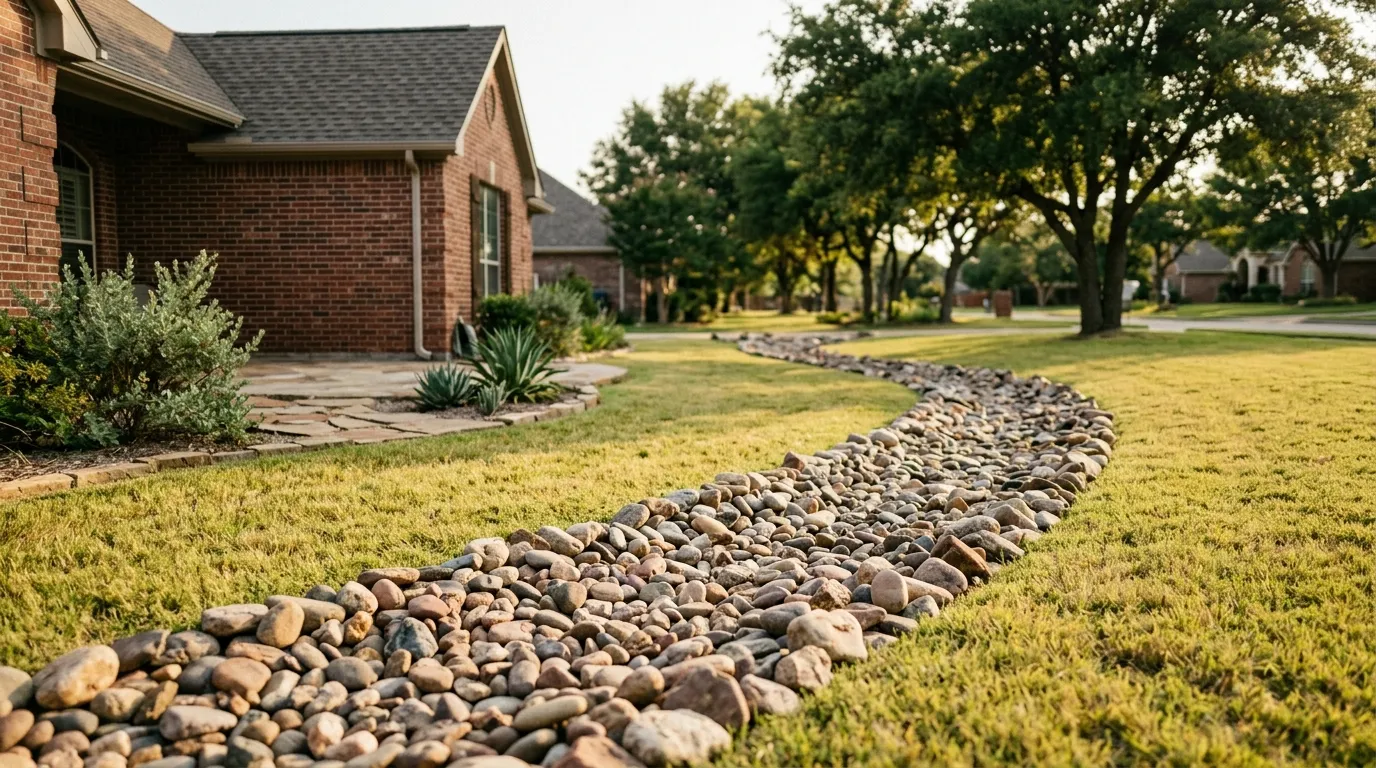
For a typical 40 ft by 3 ft dry creek bed, order 3 tons of 2" to 4" Sabine River Rock. A ton of 2" to 4" rock covers about 60 square feet at 4 inches deep. Bigger rock has to go in deeper, so a ton of 4" to 8" covers about 40 square feet. And if your real problem is a soggy yard, not water running across the top, you need a French drain, not just a pretty creek bed.
How to figure it
Here's the formula we use, and you can check it yourself:
square feet per ton = 324 ÷ (inches deep × tons per cubic yard)
The 324 turns square feet and inches into cubic yards. The "tons per cubic yard" part is how heavy the rock is. River rock runs about 1.3 to 1.4 tons per cubic yard. Bigger stones leave more air between them, so they sit at the light end, and angular rip rap packs a little heavier.
The thing that really changes your order is depth. Big rock has to go in deeper or you'll see fabric between the stones. A good rule is to lay it about one and a half times as deep as the average stone, so there's at least a couple of layers.
| Rock | Lay it about | Coverage per ton |
|---|---|---|
| Tex Mix River Rock, 3/8" to 1" | 2" deep | ~110 sq ft |
| Brazos River Rock, 1" to 3" | 3" deep | ~80 sq ft |
| Sabine River Rock, 2" to 4" | 4" deep | ~60 sq ft |
| Sabine River Rock, 4" to 8" | 6" deep | ~40 sq ft |
| Rip Rap, 4" to 8" | 8" thick | ~28 sq ft |
Every load weighs a little different, so treat these as close, not exact. We sell rock by the whole ton, so round up.
Texas Country Cobble is big specimen stone. Most people place a handful as accents instead of spreading it, so we'd count pieces, not square feet.
As of October 2026, Sabine 2" to 4" runs $78 a ton, Sabine 4" to 8" is $86 a ton, Brazos 1" to 3" is $74, Tex Mix is $68, and Texas Country Cobble is $98. Click through to each product page for the live price. Sabine 4" to 8" stock is running low right now, so check the page before you plan around it.
Worked example: a 40 ft by 3 ft dry creek bed
40 ft times 3 ft is 120 sq ft.
All Sabine 2" to 4" at about 4" deep:
120 sq ft ÷ 60 sq ft per ton = 2 tons
You'll dig the bed a few inches down and run rock up the sides, which eats more than the flat math says. So we'd order 3 tons, and you'll have a little left over for the next bed instead of fabric showing.
A mix (what we'd actually build):
- Center channel, about 2 ft wide (80 sq ft) in Sabine 2" to 4" at 4" deep: 80 ÷ 60 = about 1.3 tons
- Edges, about 6 inches each side (40 sq ft) in Sabine 4" to 8" at 6" deep: 40 ÷ 40 = about 1 ton
- A few pieces of Texas Country Cobble at the bends, if you want them
Order 2 tons of the 2" to 4" and 1 ton of the 4" to 8". That's 3 tons total, same as going all one size, it just looks more like a real creek.
2" to 4" or 4" to 8", or a mix?
Here's what we tell people.
- 2" to 4" by itself looks clean and it's easy to rake out. It's the right size for most yard creek beds that carry runoff from a downspout or a slope.
- 4" to 8" by itself holds up better where water moves fast, like the bottom of a steep run or right where a downspout dumps. On its own in a narrow bed, it can look like a pile of rocks instead of a creek.
- A mix looks the most natural. Bigger stone on the edges and the outside of each bend, smaller stone down the middle. A shovel of Tex Mix or Brazos tucked in the gaps hides fabric and fills holes.
If the water is actually cutting into a bank or a slope, that's an erosion job. Angular Rip Rap 4" to 8" ($92 a ton) locks together and stays put better than round river rock. For heavy flow, there's Large Rip Rap ($144 a ton). Call us if you're not sure which you need.
Put fabric down first
Lay woven landscape fabric in the dug-out bed before any rock goes in. It keeps the rock from sinking into our clay and keeps Bermuda from growing up through it. A 3 ft wide creek bed with the fabric run a few inches up each side fits the 4' by 100' roll, and one roll covers the whole 40 feet. For long or wide jobs, there's a 6' by 300' contractor roll.
Dig the bed a few inches down so the rock sits in it instead of on top of the lawn, and give it some fall toward where the water should go.
When you need a real French drain instead
A dry creek bed handles water running across the surface during a storm. It does not fix ground that stays wet for days. If you've got standing water, a squishy lawn, or water against the foundation, you need a buried drain: a trench with Lateral Rock (washed, angular drain rock, $42 a ton) around a 4" perforated pipe, wrapped in fabric. Our French drain sizing guide walks through the trench math.
You can do both. Plenty of people build the French drain and cap the top few inches with river rock so it looks like a creek bed. Just don't use river rock as the drain rock itself. Round stone doesn't lock the trench like angular Lateral Rock does.
What to do next
Measure the length and the average width, then run it through the rock calculator or the table above. Browse every size on the rock and gravel page.
We deliver only, and in-stock rock ordered by 10 AM can go out the same day. Delivery is $95, $135 or $185 depending on your zone across south DFW. Check your ZIP with the delivery checker. Pick a dump spot the truck can reach close to the bed. If anything's unclear, call 817-765-1655.
Also useful
- How much rock or gravel do I need: the base coverage table for every rock size
- How to size a French drain: trench sizes, drain rock tonnage, pipe and fabric
- Do you deliver to my area?: zones, fees and timing