The short version
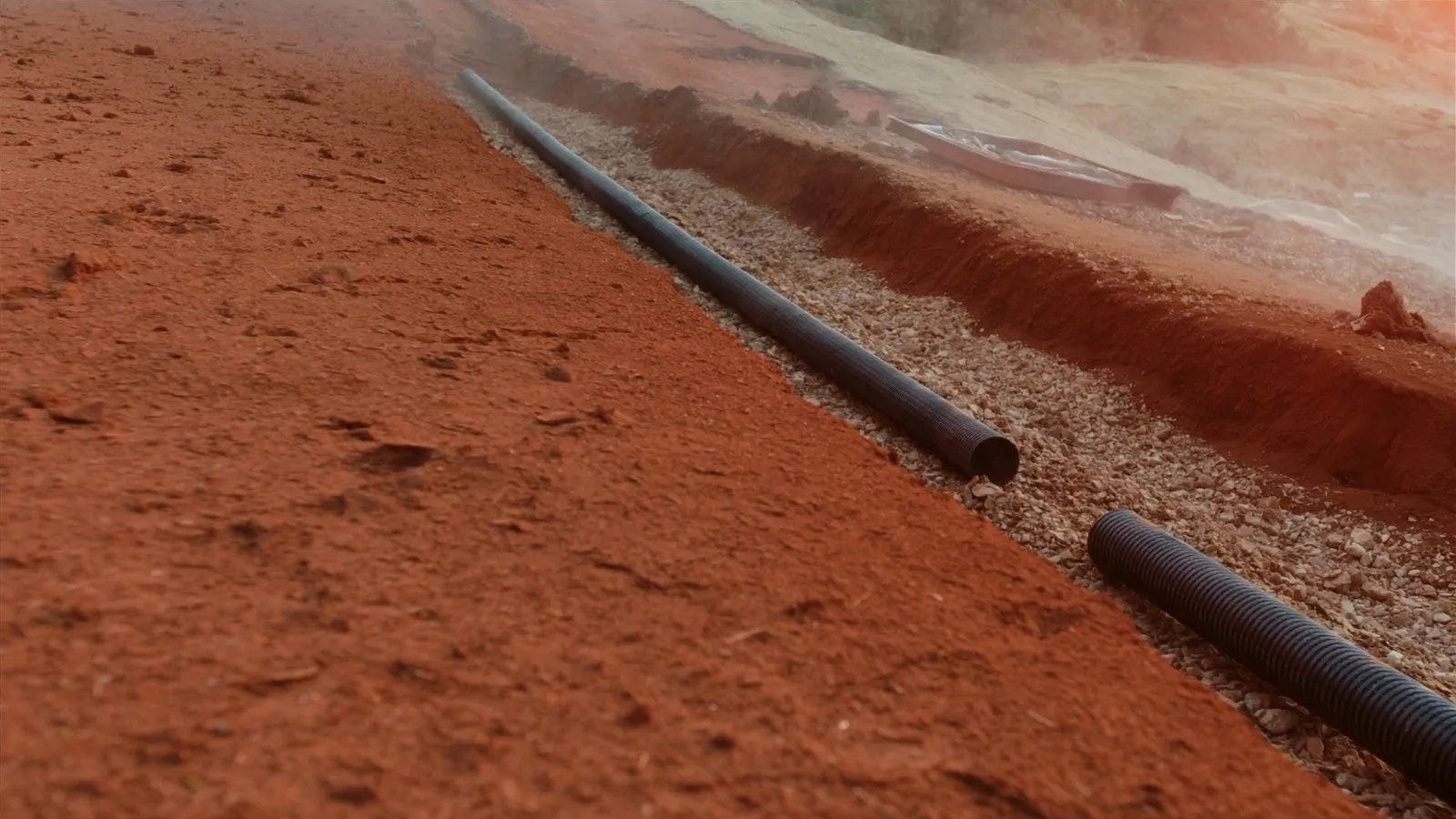
A French drain takes clean, washed, angular drain rock about 3/4" to 1.5" around a 4" perforated pipe, all wrapped in landscape fabric. For the standard 12" wide × 18" deep yard trench, that's about 0.75 tons of rock per 10 feet of trench, or 7.5 tons per 100 feet before overage. Our drain rock is Lateral Rock, the pipe is a 100' perforated coil, and the outlet run is solid pipe.
What a French drain does
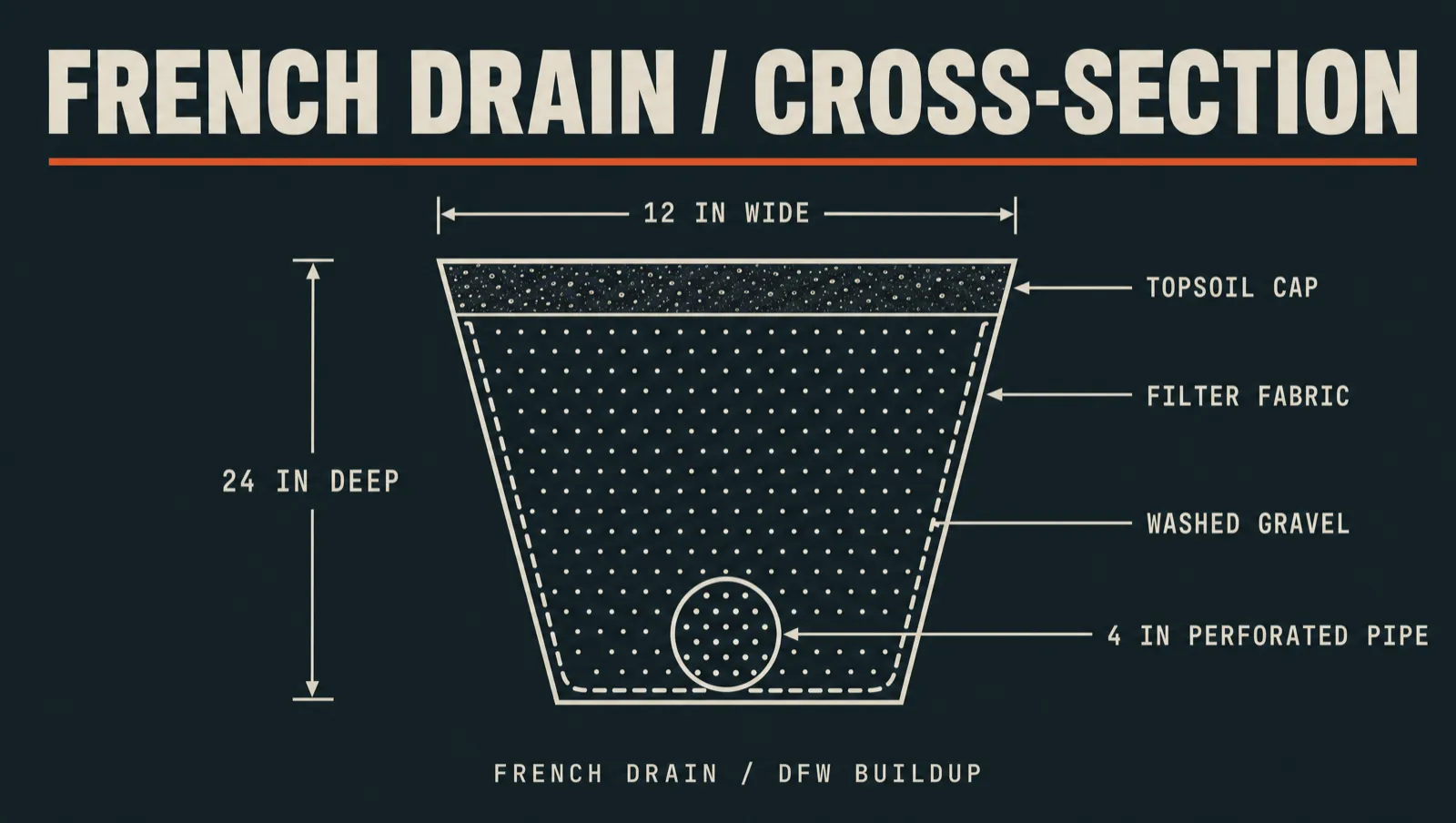
A French drain is a gravel-filled trench with a perforated pipe in the bottom. Water soaks into the rock, finds the pipe, and runs downhill to somewhere useful: the curb, a dry well, or a low corner of your own property. On North Texas clay, where water can sit on the surface for days after a storm, it's the most useful drainage fix a homeowner can build.
What size gravel goes in a French drain
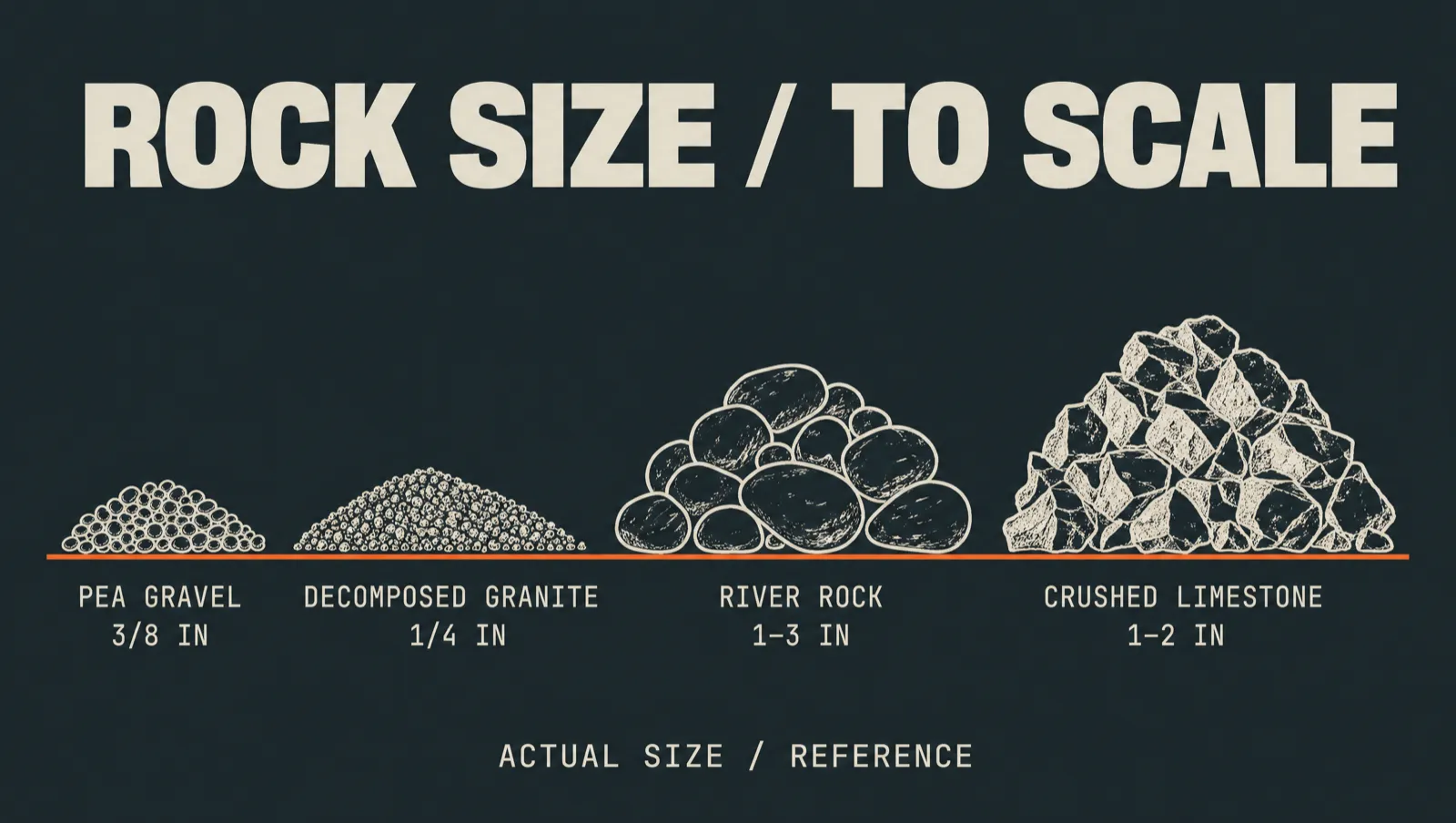
You want three things from drain rock: angular (it locks together and holds the trench shape), uniform in size (consistent gaps for water to move through), and clean (no fines to wash down and clog the pipe slots).
| Rock | Use it in a French drain? | Why |
|---|---|---|
| Lateral Rock (washed, angular, about 3/4" to 1.5") | Yes, this is the one | Washed and screened: angular, uniform, no fines |
| 3/4" utility rock | Not around the pipe | Crushed base material; good for driveway base and for a drain crossing under a driveway, but not the clean stone you want against the slots |
| 1" crushed limestone | No | Its fines pack hard, which is great for driveways and bad for drains |
| Pea gravel | No | Small rounded stones shift and pack instead of locking |
Other yards may call clean drainage stone "washed rock" or "57 rock." Whatever the name, ask for washed, angular stone in the 3/4" to 1.5" range.
How much drain rock per foot of trench
The formula, the same one our French drain wizard uses:
length (ft) × width (in) × depth (in) ÷ 144 = cubic feet
cubic feet ÷ 27 = cubic yards, × 1.35 = tons of drain rock
The pipe takes up so little of the trench that you can ignore it. Here's that math worked out for common trench sizes:
| Trench (width × depth) | Typical use | Tons per foot | 10 ft | 25 ft | 50 ft | 100 ft |
|---|---|---|---|---|---|---|
| 8" × 12" | Light yard drain, downspout run | 0.033 | 0.3 | 0.8 | 1.7 | 3.3 |
| 12" × 18" | Standard yard drain | 0.075 | 0.75 | 1.9 | 3.75 | 7.5 |
| 12" × 24" | Foundation perimeter drain | 0.10 | 1.0 | 2.5 | 5.0 | 10 |
| 18" × 24" | Heavy flow, driveway crossing | 0.15 | 1.5 | 3.75 | 7.5 | 15 |
Add about 12% and round up to the next half ton. That covers the uneven trench bottom, settling after the first rain, and the rock you spill getting it into the trench. For 50 feet of standard 12" × 18" drain:
50 ft × 0.075 tons/ft = 3.75 tons, + 12% = 4.2 tons → order 4.5 tons
Leftover drain rock is easy to use on the next project. Being a quarter ton short with an open trench is not.
The full materials list
For one standard 12" × 18" French drain:
- Drain rock: Lateral Rock, sized from the table above.
- Perforated pipe: 4" perforated drain pipe, one 100' coil per 100 feet of trench. Slotted HDPE, flexible enough to follow a curve.
- Solid outlet pipe: 4" solid drain pipe for the run from the end of the rock to the outlet, and anywhere the line passes under a driveway or walk. Solid pipe doesn't need rock around it; native soil backfill is fine.
- Landscape fabric: enough to line the trench and fold over the top. A full wrap needs about 2 × depth + 2 × width of fabric width. For a trench up to 12" × 12", that's 48", so the 4' × 100' roll wraps it in one piece. A 12" × 18" trench needs 60" (5 ft): use the 6' × 300' roll, or run two overlapping strips of the 4' roll.
- Couplers and fittings: standard 4" couplers to join coils or connect perforated to solid pipe, and a pop-up emitter if you're ending at the property line. These are sold at the yard counter.
Build order, bottom to top: fabric lining, 2" of drain rock, perforated pipe (our product pages spec it slots down), drain rock to within 4" to 6" of grade, fabric folded over the top, then topsoil and sod or a decorative stone cap.
North Texas clay: depth and slope
- Depth. 18" handles most yard drainage. Go 24" for a drain along a foundation. Clay doesn't let water soak down fast, so the job of the drain is to catch water near the surface and move it sideways by gravity.
- Slope. At least 1%, which is about 1" of drop for every 8 feet of run. 2% is better if your lot allows it. A level trench just holds water.
- Outlet. Plan the outlet first and work backward. Run to the curb, a dry well, or a low point on your own property, never onto a neighbor's yard. Check your city's rules before you cut into a curb.
- Check the grade before you order. Run a string line with a line level from the high end to the outlet. People run drains uphill because they put the outlet where it looks nicest.
- Call 811 before you dig. Gas, water and irrigation lines run right where yard drains go.
Common mistakes
- Using crushed limestone or road base as drain rock. The fines pack and seal off the pipe slots. Use washed rock.
- Skipping the fabric. Without it, clay and silt migrate into the rock and the drain clogs within a few seasons. Wrap it.
- Running perforated pipe all the way to the outlet. Switch to solid pipe where you want water carried, not collected, including under driveways.
- Under-ordering rock. Use the table, add 12%, round up.
Order it delivered
Drain rock, pipe and fabric can all come on one order. Per our delivery policy, in-stock rock and accessories ordered by 10 AM qualify for same-day delivery across south DFW. Before the truck shows up:
- Pick a drop spot the truck can reach, close to the trench (a driveway with a tarp down works well).
- Have the trench line marked and 811 called.
- Know your total trench length so the rock, pipe coils and fabric rolls all match.
Not sure of the numbers? The French drain wizard on the rock & gravel page asks for trench length, width and depth and builds the rock, pipe and fabric order for you. The rock calculator handles any other tonnage math.
Also useful
- How much rock or gravel do I need: tonnage math for beds, paths and dry creeks
- How to size a gravel driveway: for driveways that need a drain crossing
- Rock & gravel materials guide: every rock we stock, by size and use